KPNO nights 3 and 4

Hello, my name is Alexander Dillaire and I am a junior Astrophysics major at Haverford College. Tonight is the last night we will be staying at Kitt Peak; we fly out tomorrow morning. So far this has been a phenomenal experience, with no shortage of excitement. Last night, we had major technical issues that almost forced us to stop collecting data. I might be exaggerating a little on that part, but not too much. Unfortunately, the first instance of serious trouble came when I was the main person collecting data. That was really frustrating. Luckily, we tackled the problem by side-stepping the issue. It took more effort on our part, but it made things much smoother.

We also took pictures of two celestial bodies, M33 and Barnard 33. M33 is a spiral galaxy and Barnard 33 is the Horsehead nebula. All of our images came out well, which was really a highlight of the night. Both are great to look at. My partner and I are planning to make posters with our pretty images for our personal enjoyment. It was a blast taking the pictures, even if the exposure time was long. 9 minutes is a long wait for a cool picture, but they were worth it.

Tonight, we have not had much technical issues. We kept the solution from yesterday and so we are diligently taking notes. The data we are collecting from the CCD camera is turning out well, there’s just a lot of work to be done and it’s very repetitive. It’s all in the name of science, so it’s a burden we are willing to take. Overall, I think that this has been a wonderful experience. I mean, seriously, how often do you go on field trips in college. It’s the greatest. Just shows how awesome being an Astrophysics major at Haverford College is.

Awesome trip with the students to Kitt Peak National Observatory

I just returned from Kitt Peak National Observatory (KPNO) with five students. We left our colleagues Professor Steve Boughn and students Alex Dillaire and Estella de Souza behind to finish up the last two nights of our observing run on the 0.9m telescope. Erica Hopkins and Sarah Sofia have already talked a bit about our experience (that also included Mimi Fuchs, Peter Ferguson, and Mariah Baker). I had an amazing time, and the students were highly impressive in their dilligence in data acquisition, analysis, and troubleshooting. We were very busy both nights, whether obtaining time-series observations of a Milky Way globular cluster for science, observing beautiful nebulae and galaxies for fun, looking up at the sky trying to see M31 with our naked eyes, trying to figure out how to reset the emergency stop switch, filling the dewar, eating spicy hot Cheetos, or listening to music. One highlight for me was seeing both Venus and Jupiter bright in the sunrise sky at 6 am.

I could go on and on about our trip, but I really want to show a few pictures taken by Mariah Baker:

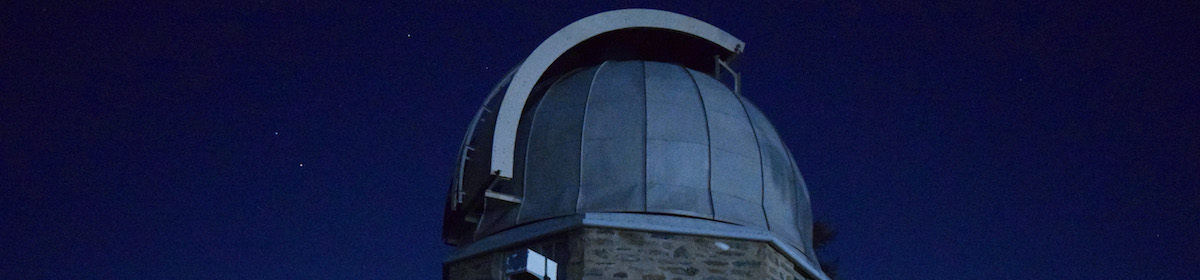
The 0.9m telescope we observe with.
View from outside our telescope.
Me with the senior astrophysics majors.
The junior majors

KPNO night 2

My name is Erica Hopkins and I’m a junior astrophysics major. Tonight was our second night observing at Kitt Peak. We had good observing for most of the night, however it got cloudy near the end. We got over a dozen images of Palomar 13 in both V and B band and a few images of Ursa Major II. Ursa Major II is only up for a short time and we lost some of that time due to bad weather. Overall it was a successful night and we look forward to continuing our observations the next two nights.

Observational Astronomy Class Trip to Kitt Peak –Night 1

Hello from Kitt Peak National Observatory!  My name is Sarah Sofia and I am a Junior Physics/Astronomy major at Haverford.  I am here observing with Haverford’s Observational Astronomy class.  We are currently on our second night of observing on the 0.9 meter telescope at Kitt Peak taking data of Palomar 13 and Ursa Major II, looking for RR lyrae variable stars.

Although we had a few struggles with weather and equipment problems our first night, we had a great night of observing.  We had a big set back at the beginning of the night after the CCD camera had warmed up significantly, making our images unusable.  However, with a lot of refilling of the dewer by my classmates, the camera was cooled back down and we were back in business for observing.  There were a few other setbacks in the night like setting off the dome alarm (DON’T hit the emergency stop!), persistent cloud cover, and Mimi and I even managed to get lost on our way to the dome (it’s VERY dark out here at night).  Despite all that, we managed to have a fun, productive time observing.  Because of the unfortunate cloud cover, we were unable to take good data of out targets.  This, however, allowed us to take some beautiful pictures of the crab nebula and the orion nebula that made the long night completely worth it.

Tonight, the observing has been fantastic with a seeing of about 1.5 arcseconds.  The night is absolutely beautiful up here, and we have been periodically standing outside to gaze at the crystal clear night sky, clearly seeing the milky way and stars we can never see at Haverford.  We’re getting great data of Palomar 13, and hopefully will continue to throughout the night.